Gijs van Roij

Building Trust in
Autonomous Driving

Framing the Question


The Lightyear project began with a focus on understanding which ADAS (Advanced Driver Assistance Systems) features consumers valued most. Early research revealed that users frequently used features like adaptive cruise control, lane-keeping assist (particularly when combined with cruise control), and accident avoidance. However, trust in these systems was fragile. A single bad experience could shatter confidence, creating a significant barrier for adoption.

How can we build user trust in ADAS systems while keeping costs low and user satisfaction high?

Our user


Quantitative Research

To address this, I participated in a broad survey of 6,000 participants, aimed at gathering insights into the Lightyear 2’s design. Embedded within this larger survey was a focus on ADAS UX. The responses reinforced that users found adaptive cruise control and lane-keeping assist essential, but only if these features didn’t operate in a jerky or unpredictable manner.


Qualitative Research

To dive deeper, I conducted 40 drive-alongs with users of recent electric vehicles. During these sessions, I observed how they used ADAS features in real-world conditions and discussed their experiences. A recurring theme emerged: users disliked lane-keeping assist because it felt too rigid, keeping them too close to the centerline. From this, we developed the "Safe Movement Zone"—an adaptive zone shown on a 3D map, allowing drivers to subtly adjust their position without disengaging the autonomous features.
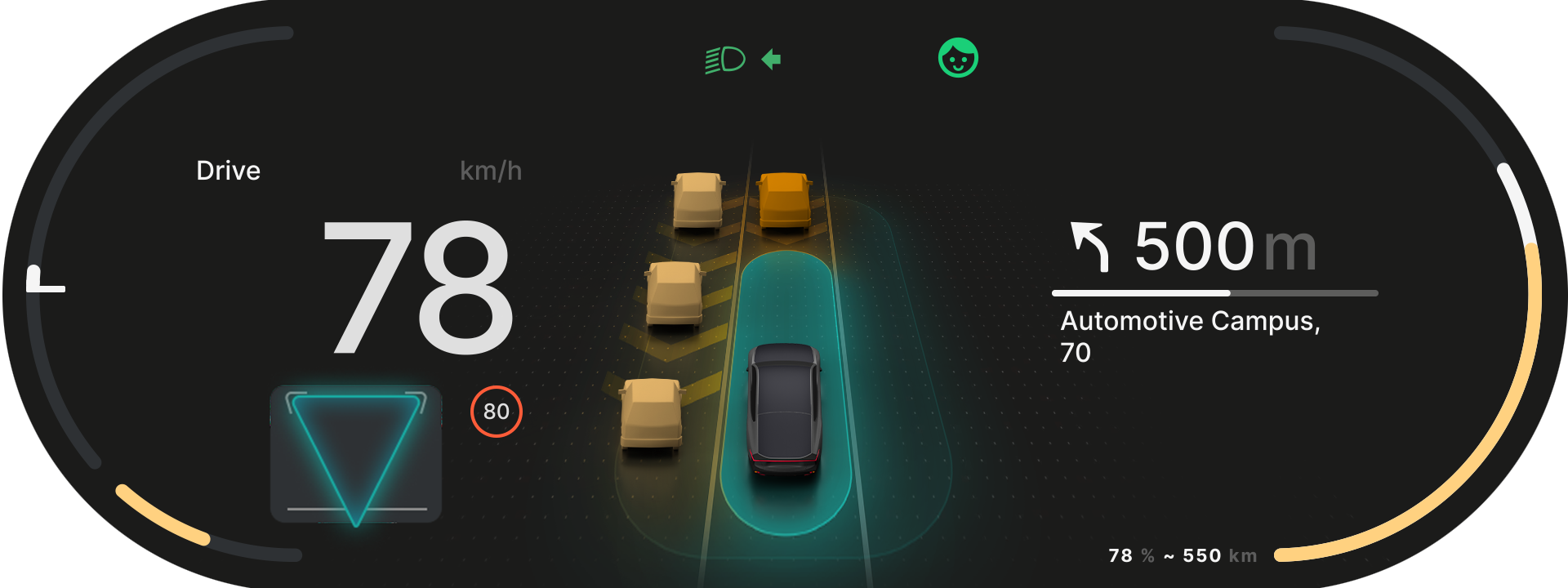
adas

Developing the interface


Through collaboration with ADAS engineers, I worked on several interface iterations that would keep the user informed of the system’s status while reducing cognitive load. Initially, I followed the common approach of visualizing the car's surroundings in 3D. However, through testing in a driving simulator—where we ran normal driving, crash avoidance, and system failure tests—we found that users were overwhelmed by having to monitor two 3D environments simultaneously: the road and the display.

This led to the development of the ADAS Trapizoid concept. This interface uses a trapezoidal shape to represent system confidence: it expands and contracts depending on the space around the vehicle and the ADAS system's current confidence levels. For example, the front of the shape widens as the distance between the car and other vehicles increases, and narrows when the system detects potential hazards.


Results

To evaluate the success of these designs, I ran a series of tests in the simulator, including uncommon occurrence scenarios like accident avoidance and system failure. Using post-test interviews and performance metrics, we measured both cognitive load and driver confidence. The results showed a significant decrease in cognitive load while using the ADAS Tapizoid interface, and users reported increased confidence in the system.

Conclusion


This project demonstrates the importance of user-centered design in ADAS development. By simplifying the interface and clearly communicating the system’s capabilities, we were able to increase driver trust without sacrificing usability or safety.

Looking for a wizkid?
Let’s create some sparks together!